
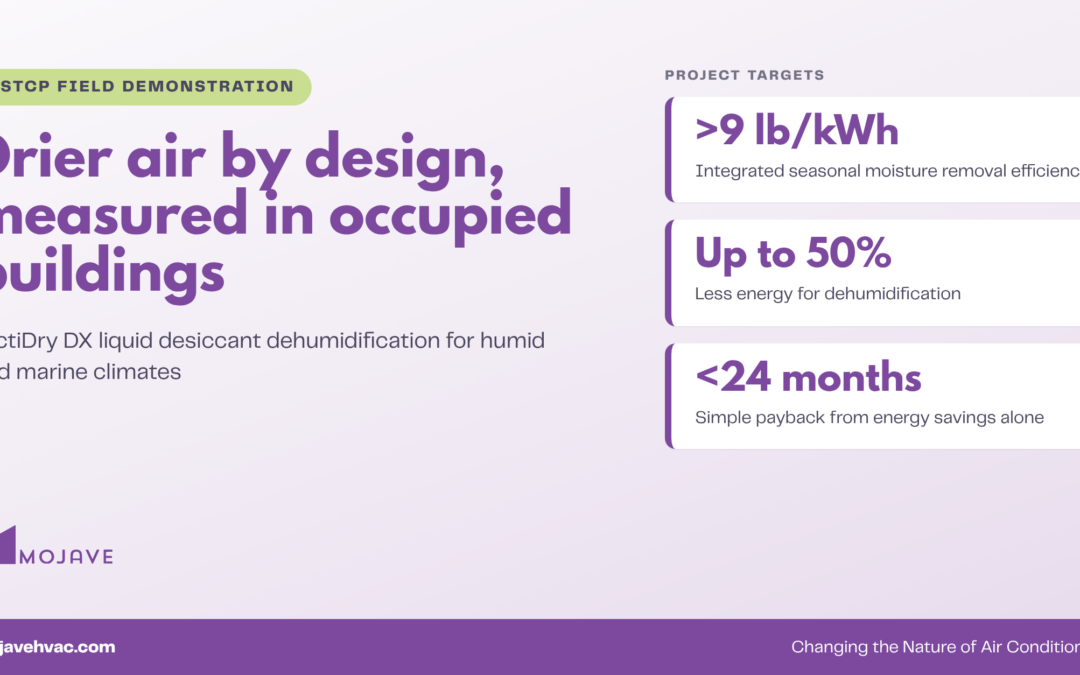
The Environmental Security Technology Certification Program (ESTCP) has selected Mojave Energy Systems to demonstrate ArctiDry DX liquid desiccant dehumidification in Department of War buildings. The project is titled Improved Moisture Control with Less Energy: Mojave Liquid Desiccant Air Conditioning (EW26-9353). It targets chronic moisture control problems in buildings in humid and marine climates.
The problem: buildings can’t stay dry
Moisture that isn’t controlled leads to mold growth and degrades building materials, and the cost of dealing with it keeps coming back. According to ESTCP, “millions of dollars are spent at DoD facilities each year on maintenance due to the negative impact of biological growth related to improper or poor relative humidity (RH) control” (source).
Conventional DOAS units remove moisture by overcooling air and then reheating it. In persistently humid conditions, that approach often fails to hold humidity where it needs to be, and the moisture problems persist.
The approach: drier air by design
ArctiDry DX uses a lithium chloride liquid desiccant to pull moisture directly out of the air. That separates dehumidification from cooling, so the unit can deliver lower dew points and hold them. By maintaining lower dew points, ArctiDry DX is expected to reduce the risk of mold and material degradation. The unit needs no domestic water, exhaust air, or complex auxiliary systems, which makes it a practical retrofit.
What the demonstration will measure
The project will replace two existing DOAS units with ArctiDry DX and monitor performance before and after the retrofit. The measurements are:
- Dew point and relative humidity: whether the space holds humidity within target ranges
- Moisture removal efficiency: a target integrated seasonal moisture removal efficiency above 9 lb/kWh
- Energy use and operating cost: the data that makes adoption fundable
How installations pay for it
The energy measurements serve a practical purpose: they give installation managers a way to fund dehumidification. The project‘s targets include up to 50% less energy for dehumidification and simple payback under 24 months from energy savings alone. Those figures exclude any benefit from reduced maintenance and moisture damage. Validated savings data is meant to support adoption through Energy Savings Performance Contracts (ESPC) and Utility Energy Service Contracts (UESC).
“Humidity control is easy to promise and hard to prove. A demonstration like this one measures what the equipment actually does in occupied buildings, under real conditions, against the systems it replaces. That’s the kind of evidence engineers and owners should expect from any new technology, including ours.” — Aaron Meles, VP of Product, Mojave Energy Systems, Principal Investigator for EW26-9353
What’s next
The project is in its early stages, with completion anticipated in 2028. We’ll share updates as units are installed and data becomes available.
Read the full project description on the ESTCP website →
About ESTCP: The Environmental Security Technology Certification Program demonstrates and validates innovative technologies in real-world conditions at Department of War facilities.